
WHERE IT GOES WRONG
The cost shows up later
The feeder is usually the last thing specced and the first thing that caps the line. A feeder picked off a catalog jams on the head style or the flash nobody checked, and hand-feeding works until volume climbs, at which point it becomes the rate limit.
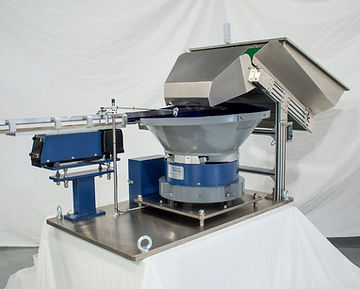
For a part that stays put, dedicated feeding is still the cheapest and fastest way to run it. A bowl tooled to your part, a step feeder built around your fastener, an in-line track and a hopper sized to the rate you actually need. What it costs you is flexibility, so the question worth answering early is how often that part is going to change.
HOW TO CHOOSE
Match the technology to the job
Dedicated feeding carries most of the volume on most lines, and the part and the rate pick the platform:
- High volume, one part that rarely changes → a vibratory bowl feeder, custom-tooled to the part. Cheapest per part and fastest at volume, slow and expensive to change. Bellco builds these to order, with the hoppers, in-line tracks, escapements, and sound enclosures around them. (Bellco Feeders.)
- Screws and fasteners into a driver → step feeding matched to the screwdriving head, built for the fastener instead of adapted to it. Weber's ZEL step feeders handle fasteners to M16 and 160 mm, including the head styles a bowl won't feed reliably. (Weber.)
- Parts staged between operations → in-line tracks, escapements, and bulk hoppers sized to the rate, so the feeder buffers the line instead of starving it.
- Many part numbers, or parts too small or fragile for a bowl → flexible feeding, where a camera finds oriented parts and a part change is a recipe instead of new tooling. That lane has its own page: flexible feeding.
- Inside a cleanroom or GMP Annex 1 isolator → a feeder engineered for aseptic entry and wash-down, which rewrites the requirements before speed or part size matter. See cleanroom feeding.
The recommendation follows the part instead of the product we happen to carry. One part at volume is cheaper and faster on a dedicated bowl, and a line running a dozen part numbers earns the flexible-feeder premium back in changeover time. If your part won't feed reliably at all, we'll say that too.
WHY M6
One source, sized to the application
Feeding is the step where a feasibility answer is worth more than a quote. Send us the part drawing and the rate and we'll tell you which lane fits, whether the part will feed, and what it should roughly cost, as a free feed study, before you spend anything. We carry bowl, step, in-line, and flexible feeding across Washington, Oregon, Idaho, British Columbia, and California, and the team that specs the feeder supports it after it ships.
You leave knowing which feeding lane fits your part and your rate, bowl, step, in-line, or flexible, and whether the part will feed at all, before anyone quotes you.
WHAT WE CARRY
The lines we rep for this application
- Bellco Feeders: custom vibratory bowls, step feeders, in-line tracks, escapements, bulk hoppers, and sound enclosures, tooled to your part.
- Weber: step feeders (the ZEL family) and bowl feeding matched to automated screwdriving, fasteners to M16 and 160 mm.
- Asyril and FlexiBowl by ARS: the flexible lane, for when the part changes often or is too small or delicate for a bowl. Details on the flexible feeding page.
Industries: Assembly, medical device, electronics, automotive, consumer products
THE EQUIPMENT
What this looks like on the floor


THE COST OF WAITING
An automation project gets approved with two numbers
One is the equipment quote. The other is what doing this by hand costs you every month, and only you can add it up:
Labor on the task. Hours per shift, at your fully loaded rate.
The rate ceiling. What the manual step caps your throughput at.
Scrap and rework. What manual variation costs you per thousand parts.
Changeover. Time lost every time the part changes.
The hiring problem. Turnover, training, and the weeks the job sits open.
Exposure. Repetitive lift, pinch points, and what one recordable costs you.
We will get you the equipment number and a budget range early, so your request goes up with both.
Same-day reply from a specialist · Free assessment · Free part testing
COMMON QUESTIONS
Common questions
What areas do you support parts feeding in?
M6 Revolutions supplies and supports bowl, step, in-line, and flexible feeding across Washington, Oregon, Idaho, British Columbia, and California, with free feed studies on your actual parts.
Bowl feeder or flexible feeder for my part?
One locked-down part at high volume: a dedicated bowl wins on cost and rate. Parts that change, tangle, mar, or come in families: flexible feeding wins, because changeover is a software recipe done in minutes. The answer follows your part.
How do I find out if my part can be fed?
Send the part or a drawing and we'll run a free feed study: a straight feasibility answer and a recommended platform before you spend anything.
What happens when the part changes?
On a dedicated bowl a new part usually means new tooling and a lead time, and that is the cost people underestimate most often. If you already know the part is going to change, or the line runs several part numbers, price the flexible lane before you commit to tooling.
Will the feeder work with our robot and vision?
Yes. The feeding platforms integrate with all major robot brands, and we support the full handoff so the feeder and the robot come up together.
GO DEEPER
Guides
- Bowl Feeders and Flexible Feeders Win Different Factories
- How to Choose a Flexible Feeder: 5 Questions to Ask First
- What Is the Best Feeder for Medical-Device Cleanroom Assembly?
- How to Automate High-Mix, Low-Volume Production Without Betting the Shop
- Mastering High Mix, Low Volume Manufacturing with Flexible Automation (Blog)
- 5 Things That Set the Price of a Parts Feeding System